

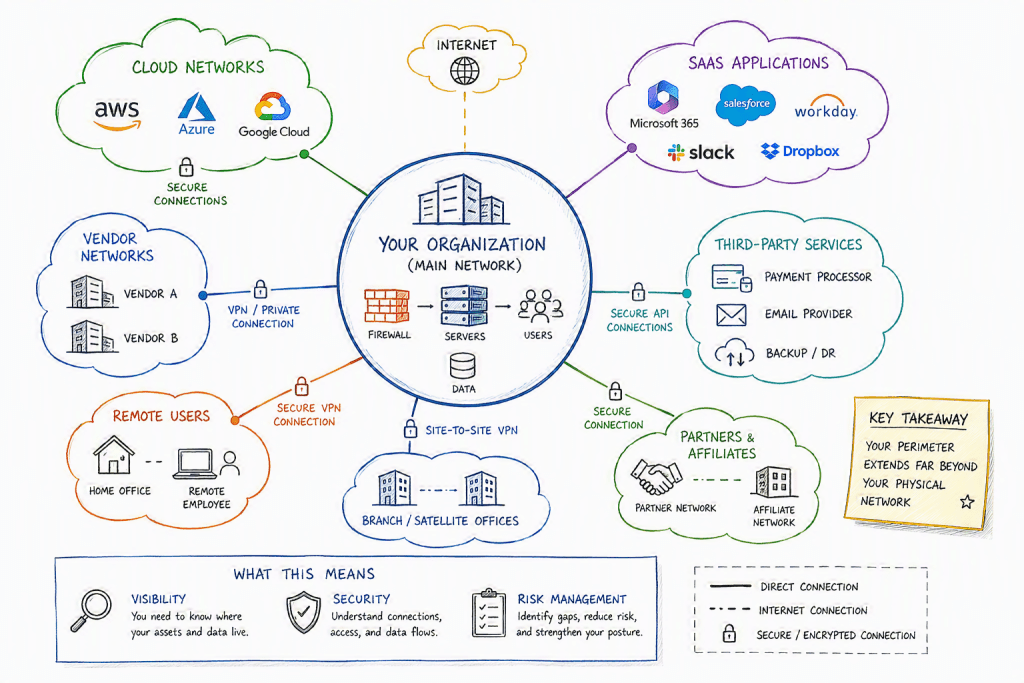
Defining your organization’s perimeter is more challenging than ever. Today’s technical environments extend far beyond the traditional corporate network to include cloud platforms such as AWS, Azure, and Google Cloud; SaaS applications; home offices; satellite locations; wireless networks; third-party vendors; and managed service providers (MSPs).
In most organizations, the network is no longer “contained” in the way it once was. The rise of remote work, increased reliance on cloud services, and growing integration with external partners have created a much more fluid perimeter. On top of that, identity has become its own perimeter, extending access beyond physical and cloud networks to applications, services, and data repositories.
For smaller organizations, MSPs may play a significant role in managing infrastructure and access. For larger enterprises, vendor and partner relationships can extend the perimeter across regions and even around the globe.
So, Where Does That Leave You?
It starts with an honest assessment of what your environment actually looks like and where your data truly resides. Understanding the full scope of your ecosystem is one of the most important steps in effectively managing and securing it.
Ask Yourself These 5 Questions
- Where are your assets located, and are they physical, virtual, cloud-based, or a combination of all three?
- Do satellite offices or remote employees extend your network footprint?
- Are there site-to-site connections, VPNs, or third-party relationships that expand your network boundary?
- Do APIs connect your systems to hosted or vendor-managed applications that store or transfer data outside your environment?
- Are there SaaS applications, outside your direct ownership or management, that store, process, or share your data?
Three Diagrams Every Organization Should Maintain
Understanding your true perimeter requires more than an asset inventory. The following diagrams provide critical visibility into your environment:
1. Data Flow Diagram
A data flow diagram illustrates where your data resides, how it moves, and who has access to it. If your organization handles multiple business processes, partners, or data types, you may need several diagrams to accurately represent data movement
2. Network Diagram
This diagram should document your managed infrastructure across both on-premises and cloud environments. It should include key systems, network segments, connectivity, and security controls.
3. Perimeter Diagram
A perimeter diagram provides a broader view of your environment, including external connections, partner networks, cloud services, identity providers, remote access solutions, and third-party relationships. Its purpose is to show the complete ecosystem surrounding your assets and data.
Some Organizations Have It Easy, Others Don’t
Some organizations can quickly map their environment. They may rely primarily on Microsoft 365, Azure, and SharePoint, with limited external integrations and a well-understood data footprint.
Others may have accumulated years of technology decisions, cloud services, vendor relationships, and business processes that make their environment much more difficult to visualize.
Regardless of where you fall on that spectrum, the goal remains the same: understand your environment before attempting to secure it.
Next Steps
Here are several practical ways to get started:
- Talk to your network team. Existing network diagrams may provide a strong foundation. If documentation is incomplete, conduct interviews and begin building draft diagrams.
- Meet with application owners and cloud administrators. Gather information about business applications, hosting environments, data storage locations, integrations, and APIs.
- Perform external reconnaissance. Review public-facing assets using certificate transparency logs, ARIN records, DNS data, and search engines to identify systems and services associated with your organization.
- Interview staff across departments. Determine what tools employees use and identify any shadow IT solutions that may exist outside approved processes.
- Analyze network and DNS traffic. Monitoring activity can reveal applications, services, and destinations that may not appear in official documentation.
Final Thoughts
Understanding where your assets, data, and connections reside is a foundational step in managing cybersecurity risk. In our experience, organizations almost always discover overlooked assets, undocumented integrations, or unexpected third-party dependencies when they begin mapping their environment.
The reality is simple: you cannot protect what you do not know exists.
If you’re unsure where to start, we’re happy to help. Reach out to discuss your environment and the next steps toward building a clearer picture of your organization’s true perimeter.